Journal 01 · Field notes
Nobody certifies the skid. They will still try to sell you one.
A salesperson can put GMP on a drawing. An inspector cannot put a certificate on a machine. The gap between those two sentences is where a lot of cannabis money goes to die.
01The sentence on the skid
You have heard the sentence. It arrives about twenty minutes into a demo, after the solvent recovery numbers, before anyone has opened a drawing of your building. Never true, and said anyway: “This unit is GMP certified.” Sometimes they say GMP-ready. Sometimes EU-GMP compliant, which a machine cannot be. Sometimes there is a little badge on the last slide. Stainless gleams. Everyone in the room wants it to be true, because if the machine were the certificate, you would not have to argue with a production room, a quality unit, or a Site Master File.
It is not true. Not for Decimal’s machines. Not for anyone else’s. Not in the EU, not under FDA, not because a state cannabis license used the letters. This piece is about the wash: how the claim is built, why it lands, and the six boring questions that make it fall apart. We will not sell you a skid at the end. We will tell you what an inspector actually opens.
02What GMP-washing is
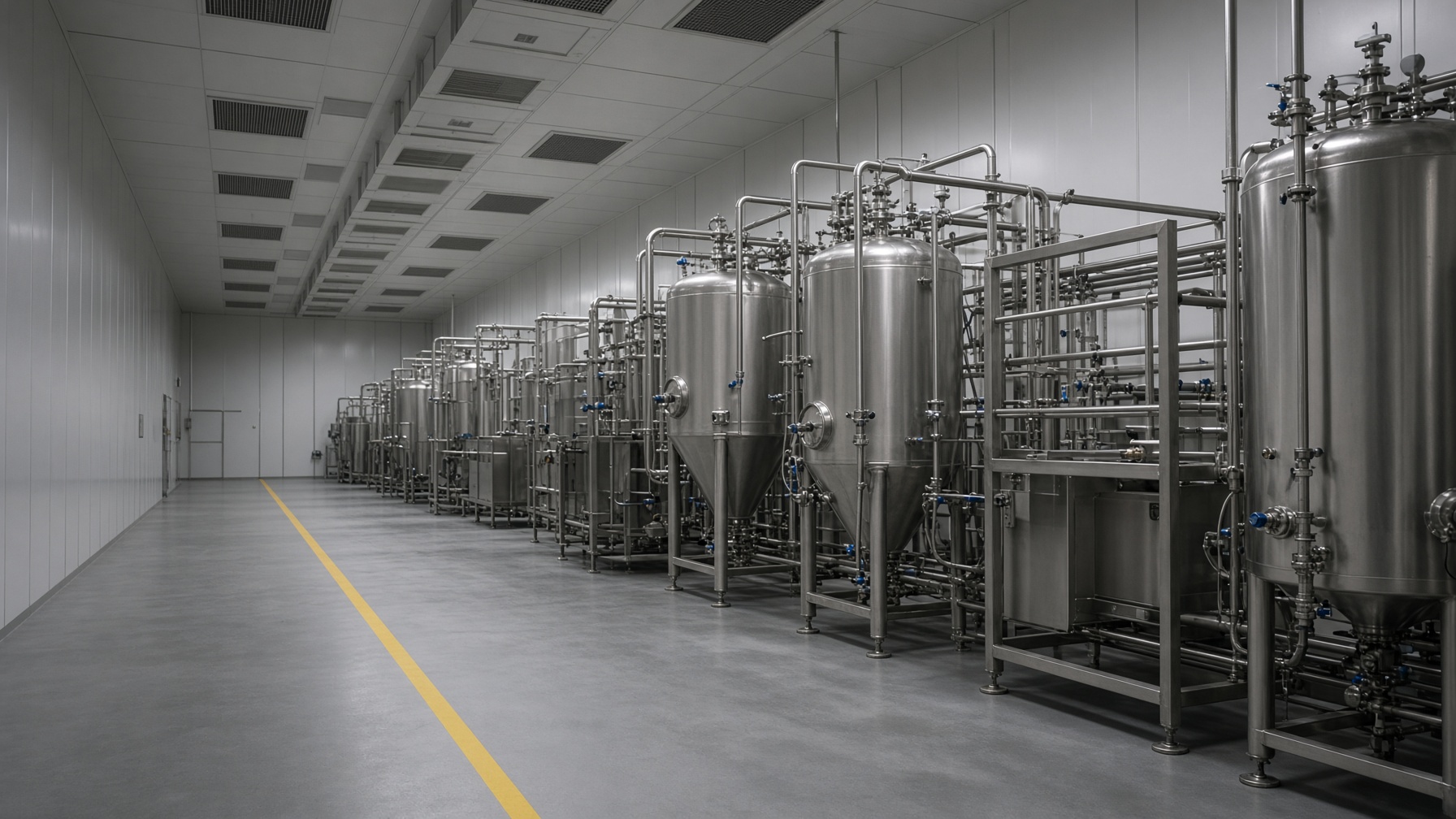
Greenwashing, in the environmental sense, is a label with no work behind it. GMP-washing is the same trick with a pharmaceutical vocabulary. The supplier uses the letters because buyers of cannabis and hemp extracts have started to need them — for a German importer, for a QP who will not release a batch, for a board that heard “EU medical” in a pitch. The equipment looks the part on a website. Product-contact steel. A tri-clamp. A sentence about sanitary design. That is often the entire file.
The wash works because the buyer is tired. They have already spent a year on HVAC, a year on a license, a year being told that extraction is manufacturing. They want one crate that closes the argument. A hollow GMP claim offers that crate. The bill arrives later: at IQ, when nobody can find a material certificate; at OQ, when a dead leg cannot be cleaned; at the inspection, when the inspector does not care what the brochure said.
The badge is cheap. The missing 3.1 certificate is not.
03Who actually gets inspected
A GMP certificate — in the EU, after a competent-authority inspection of a manufacturing site; in the US, the analog is not a sticker either, it is a facility that has been inspected against 21 CFR 210 and 211 or against ICH Q7 for an API — is issued to a site. The inspector walks rooms. They read SOPs. They ask who can stop a batch. They look at whether the equipment in front of them can be cleaned, maintained, and qualified in that building, on that process.
Annex 15 is the EU text for qualification and validation. IQ, OQ, PQ are yours. They are not a PDF the OEM emails you with the serial number. A vendor can make qualification possible: materials of construction, surface finish, drainability, a documentation pack a third party can use. That is a serious conversation. It is not a certificate hanging on the skid.
Read that slowly if you sell equipment, or if you are about to write a PO. Suitable design is a requirement on you, the manufacturer of the medicine or the substance. The OEM is a supplier. Your quality unit still has to say the thing is fit. No honest supplier can take that sentence off your plate.
04Six tells
None of these is a crime. Together they are a pattern. If three of them show up in one deck, you are not looking at a documentation pack. You are looking at a wash.
01
“GMP certified equipment”
The phrase itself. Certificates go to sites. If the slide cannot bear to say “designed to support a GMP process” and insist on certified, stop there. Ask who issued the certificate, to whom, on what date, after which inspection. Watch the room.
02
Stainless as the whole argument
304 or 316L is a material, not a contamination-control strategy. Product-contact steel is table stakes. The questions are finish, welds, dead legs, slope, whether a gasket can be pulled, whether the thing drains. “It’s stainless” is how you sell a tank to a brewery. It is not how you answer Annex 7.
03
No mill certificates, no heat numbers
EN 10204 3.1 on product-contact parts is not romance. It is how you prove what the steel is when an inspector asks. If the vendor shrugs, or says “we can get that if the deal is big enough,” you have just been told the file does not exist yet. You will pay to invent it.
04
Dead legs, described as a vibe
Ask where the low points are. Ask how a rinse leaves. Ask which connections are dummy-welded because someone did not want to machine a drain. A designer who has lived through a swab will answer without a slide. A designer who has not will talk about “sanitary-ish.”
05
IQ / OQ is “phase two”
Qualification protocols written against your process, in your room, with your utilities, are the work. A vendor who says “support available” and has no sample protocol, no recommended test points, no list of instruments that need calibration, is selling you a crate and a future invoice.
06
The badge with no author
Flags, seals, “meets GMP,” a PDF with no revision history, no named engineer, no drawing number. If you would not put it in a batch record, do not put it in a capex memo.
05What to ask before you buy
You do not need to be a QP to run this list. You need to write the answers down and keep them. If a salesperson cannot sit still for it, that is also an answer.
- What is product-contact? Steel grade, surface finish (Ra), weld standard. Which of those have certificates you can have before the crate ships.
- How is it cleaned in place, or taken apart? What does not drain. Where a swab will fail first.
- What spare elastomers are, and whether they are the same compound the drawing names.
- What the IQ/OQ pack actually contains — not “we help with that.” A table of contents. A sample. Names.
- Whether the design was reviewed against a named text (EudraLex Vol 4, Annex 7, ICH Q7 §5, 21 CFR 211.63–68) or against “GMP” as an atmosphere.
- What happens when you change a pump. Change control is your system. The vendor should still be able to tell you which drawings move.
A longer, equipment-buyer version of that list lives on a sister site we disclose below. The rule here is the same: specific answers, or you are shopping a label.
06EU, FDA, a state sticker
The wash loves to collapse jurisdictions. “We do GMP” is made to sound like it covers a German importer, an FDA investigator, and a state cannabis inspector in one breath. It does not.
EU medicinal: the site is inspected by a competent authority. Equipment is part of the premises. Qualification is Annex 15. Herbal specifics sit in Annex 7. A Canadian or US domestic cannabis standard is not a substitute. If you are trying to export an extract as a starting material into that world, the gap is not a nicer centrifuge. It is the file, the rooms, and a QP who will put their name on a batch.
US: 21 CFR 210/211 if you are in that system. ICH Q7 if the fraction is an API. FDA’s drug program does not, as a rule, inspect a state-licensed adult-use cannabis extraction lab. A state walkthrough is not a six-systems inspection. Buying “GMP equipment” for a state license does not summon FDA, and it does not replace the state.
Full comparison: cGMP, EU-GMP, and state cannabis rules. The short version: pick the text you are actually under, then ask whether the machine can be qualified against it in your rooms.
07What this house will not say
GMPEquipment shares a house with Decimal Engineered Systems, who make extraction equipment, and with Opsona, who make software for regulated manufacturing. We disclose that on purpose, because the wash we are describing is exactly the temptation of a shared house: to let the education launder a certificate onto a crate.
We will not. Decimal can say a machine was designed and documented to support an EU-GMP facility. That sentence has a meaning. It is not a certificate, it does not travel with the serial number, and it does not inspect your production room. If a claim on this site ever sounds stronger than that, it is a mistake — send it to hello@gmpequipment.com and we will cut it.
The spoke this article exists to protect: Is equipment ever “GMP certified”? The answer is no. The disclosure: Decimal.
08Short answers
- What is GMP-washing?
- Using the letters with only the minimum behind them — usually stainless and a badge — so a crate looks inspected. The gaps show up at qualification or at the authority, not on the website.
- How do I spot it?
- They will not talk about dead legs, mill certificates, surface finish, or a real IQ/OQ pack. They will talk about the machine being certified. Ask who certified it.
- Does a domestic cannabis standard make a machine EU-GMP ready?
- No. Different bars: sanitary design, documentation, qualification, traceability. The export problem is the site, not a flag on the crate.
- Can any supplier sell me certified equipment?
- No. Treat the offer as a warning. The strongest honest sentence is: designed and documented to support a certified facility — backed by documents you can read before the PO.
If you want a person to walk the rooms against the published text, that is the intake. If you want the one-line ruling: the machine is not the certificate.
Educational only. Not legal or compliance advice. A person wrote this. Charlie did not. How we verify sources.